There is a big gap between the Part 61 MOS requirements and CASA’s guidelines in their draft sample training syllabus. CASA recommends:
- Spin instructors must know more than the underpinning knowledge described in units of competency FAE-8 & FIR-TE18! The applicant must also demonstrate extensive knowledge of the units of competency published in the Part 61 MOS for the grant of a spinning endorsement. I have been recommending that for many years. •Definition of a spin per AC 23-8 •Certification standards •Differences in recovery techniques between different types •Advanced spin modes •Characteristics of types not approved for intentional spins
- The CASA syllabus has 10.7 hrs of ground training pprior to the flight section of the course which includes a further 6.5 hrs of ground training.
- Tutorial TE18-12 should be used to guide the trainee in the common faults that a student under training for a spinning flight activity endorsement can make and their common root cause. The discussion should provide guidance on how to deal with the faults in relation to repeat demonstrations and direction techniques with emphasis on ensuring the continuing safety of flight.
- Tutorial TE18-13 should be used to guide the trainee on the more common aircraft mismanagement occurrences in spinning training that result in an undesired aircraft state with emphasis on recognition and recovery from aircraft upset. Common student actions that can lead to an upset should be discussed along with early recognition and intervention techniques to manage.
From the Facebook page of the Australian Transport Safety Board in 2022: “The ATSB is advising aerobatic pilots and instructors of the limitations of the Meuller/Beggs spin recovery method for some aircraft types, after an investigation into an aerobatics training flight accident on Queensland’s Sunshine Coast.”
The report is available here https://www.atsb.gov.au/media/news-items/2022/spin-recovery/
The report includes this Safety Advisory Notice:
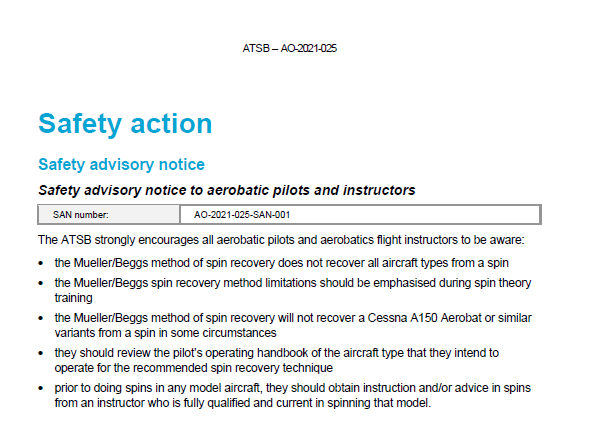
It seems to me that the current situation here is similar to that in the USA back in the ‘70s where Cessna, the FAA and the National Association of Flight Instructors addressed their situation which the NTSB described later as “Detailed investigation by the FAA, however, disclosed that problems were related to operational vagaries or anomalies, inadequate knowledge regarding the precise spin recovery procedures for the airplane, improper application or misapplication of recovery controls, apprehension, and confusion.”
Just like the Chipmunk saga here back in the ‘50s when the Director-General of Civil Aviation commented: “Throughout aviation history situations have arisen wherein half truths and rumours relating to the characteristics of a particular aircraft type have engendered uneasiness and doubt as to its true performance, often to a stage where safety is seriously compromised. Where this has happened confidence has only been restored after the issue of competent judgement based on indisputable facts.”
I downloaded a copy of an aerobatic manual for the Cessna 152 Aerobat from a flight school in this part of the world. They teach a spin recovery method contrary to the POH – why? Cessna states that “reversing the sequence of rudder-elevator inputs or even slow, rather than brisk, inputs may lengthen recoveries”. The document from the flight school describes the Emergency Spin Recovery Procedure as “apply full opposite rudder and release the control column” i.e. Beggs-Mueller. Dangerous misinformation because we know what Beggs and Kershner discovered about the Cessna.
I recently bought a book on aerobatics which was acclaimed by aerobatic pilots on Facebook. It states that “Most modern airplanes will eventually recover from an inside spin on its own if you let go of the stick and rudder controls (see research done by German pilot Eric Mueller and American pilot Gene Beggs).” Dangerous and half-baked because that is contrary to what Eric and Gene state. In 1978, Cessna’s test pilot referred to that same half-baked truth as it has been around for many years. He demonstrated a “hands off” recovery after two turns in a 150 which did occur but took much longer than the POH method. He went on to say that there was no certification requirement to test a “hands-off” recovery. Just because it worked from a normal spin after two turns does not mean that it will work from other spin modes. In fact, Kershner has shown that “hands off” recoveries will generally not work in the Cessna.
This CASA magazine article mentions “a cesspit of misinformation, half-baked truths and misshapen facts fertilised by the manure of their daily postings.” Indeed! https://www.flightsafetyaustralia.com/2017/12/the-unreachables-are-they-unteachable/
At the UPRT Provider’s Conference on 1 August 2022, David Pilkington presented (amongst other things) innformation on similar issues with spin and aerobatic instructor training. There were some definite recommendations for spin instructors which would’ve addressed the ATSB’s SAN.
My discussion paper on spin training issues is available below. Feel free to provide feedback.